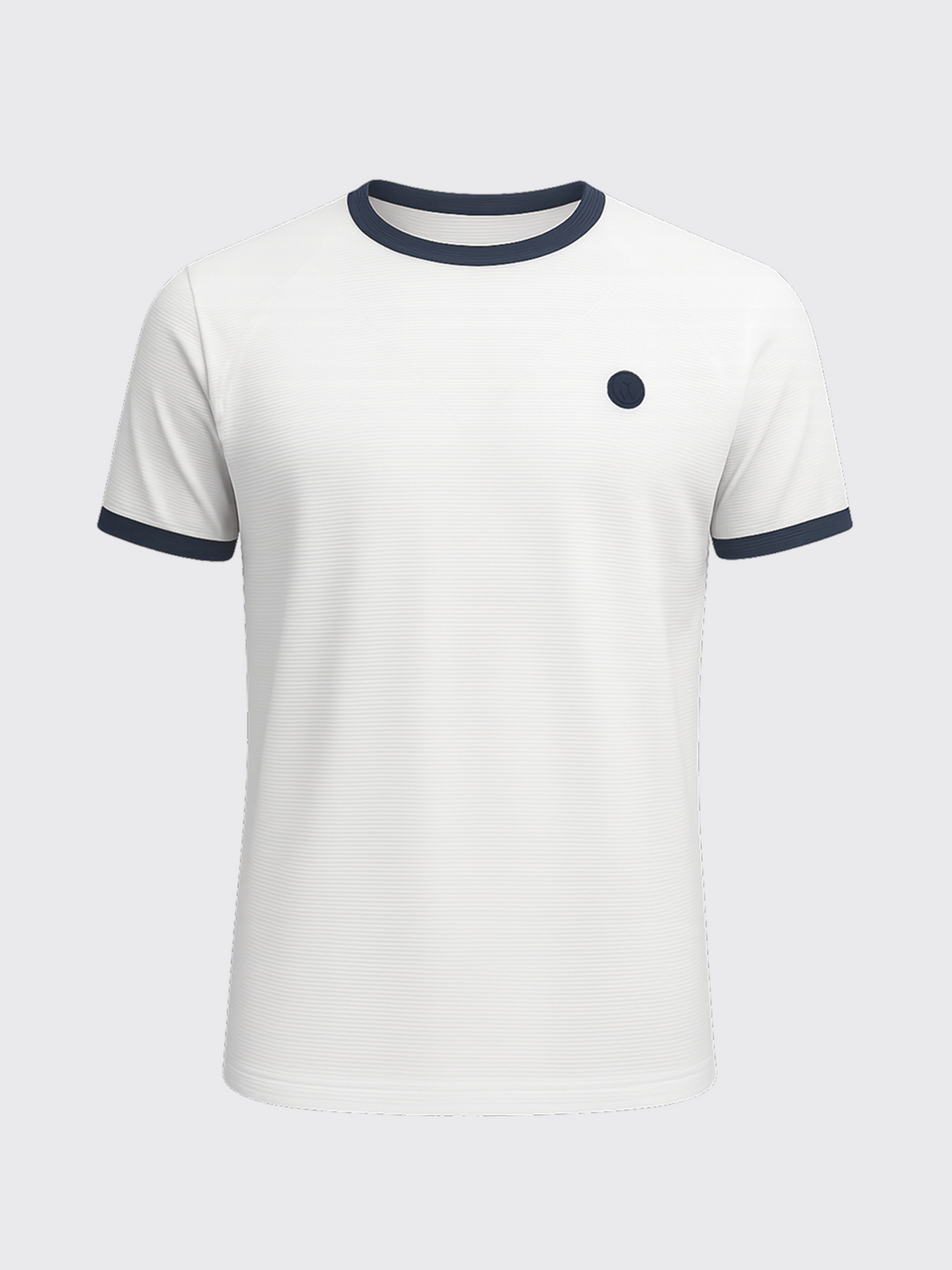
Fabric MERINO
The Scienceof Merino
A sheep gets sheared once a year. The rest of the time, it gets through dry summers and sub-zero mountain winter nights wearing the same fleece. One fiber, two opposite seasons. We went down to 8 nanometers to figure out how it pulls that off.
Key figures for merino wool
of its dry weight in water vapor, with no damp feeling.
released per kilo of dry wool, in addition to the condensation of the water itself.
lower intensity than polyester after wear, based on olfactory panel testing.
the diameter of the yarn we have spun. The market standard is around 18.5 to 19.
insulates against cold and heat alike
Wear Wool All Year Round
One fiber, worn from January to December.
Here's what's happening underneath.
Knit
At 20x, the knit disappears. What's left is geometry: loops threaded through one another, with empty space in between.
That empty space does half the work. A 160 g/m² jersey is 80% air by volume, and air is a poor conductor of heat.
In winter, that trapped air slows the escape of your body heat.
In summer, the knit switches roles. It blocks solar radiation and lets vapor escape. Insulation isn't doing the work anymore — permeability is.

Fig. 01
The Yarn
The yarn isn't a single strand. It's a cable.
We have it spun at Südwolle as a two-ply twist: two strands twisted into a helix, in opposite directions from each other. The opposing twist locks the whole thing together. Fiber ends migrate to the surface far less, so the knit pills that much less.
Nobody can promise a knit that never pills. Woolmark says so in black and white. What you can do is push that day back several seasons.

Fig. 02 Skein, two-ply twisted yarn
The bilateralcortex
Cut the fiber crosswise and the cross-section isn't uniform.
Two populations of cortical cells sit side by side: the orthocortex, and the paracortex, which is richer in sulfur. They don't respond to moisture the same way, and they're not the same length.
Orthocortex cells, on the outer side of the curve, are longer than paracortex cells on the inner side. That difference is set in the follicle the moment the fiber keratinizes. A fiber with one side longer than the other curves. Repeat that down the full length and you get crimp.
Crimp creates loft. Loft creates the trapped air from tier 01. An asymmetry set in a sheep's skin travels all the way up to how warm you feel.

Fig. 05 Cross-section, bilateral division
Eightnanometres
Last tier. Keratin organizes into intermediate filaments 8 nanometers in diameter, spaced about 11 nanometers apart, embedded in a sulfur-rich matrix.
Between them runs a network of pores narrowing down to 4 nanometers. A water molecule measures about 0.3 nanometers. It passes through without any trouble.
At saturation, the gap between filaments widens by about 14%. The fiber breathes in the strictest sense of the word — it changes dimension based on the air moving through it.

Fig. 06 Fiber bundle, structural analysis
The Comeback · Winter
The Fiber ThatWarms You Up
Every water molecule that bonds to keratin releases energy. The reaction is exothermic, and it's measurable.
A kilo of dry wool releases about 113 kilojoules as it takes on moisture, on top of the heat of condensation from the water itself. No other common fiber does better: cotton tops out at 46, polyester at 10.
That release plays out over several dozen minutes. You step out into the cold and damp, the fiber pulls moisture from the air, and it keeps generating heat for as long as you need it.
The Ascent · Summer
The Fiber ThatBuys You Time
In summer, the same mechanism runs in reverse.
At rest, your skin sheds about 350 milliliters of water a day without you ever noticing. During exercise, sweat output commonly climbs to 0.5 to 2 liters an hour. It's the evaporation of that water that cools you down.
Merino catches the vapor before it turns into liquid sweat, stores it, then releases it gradually. Cooling spreads out instead of hitting you all at once.
Meanwhile, a fatty-acid monolayer chemically bonded to the fiber's surface makes it non-wettable. The water stays inside the fiber, not on top of it.
The Long-Wear Test
Thirteen Noses,Twenty-Eight Days
A New Zealand team had nine different knits sewn into the underarms of T-shirts, had five men wear them for two days each, then had the samples assessed by thirteen smell testers after one day, seven days, and twenty-eight days.
The ranking held at all three checkpoints. Wool came out significantly less odorous than cotton, and cotton significantly less than polyester.
The explanation lies in the mechanism of level 04. Odorous compounds are captured inside the fiber, in an environment where bacteria do not proliferate. They are not destroyed; they are sequestered. Washing releases them.
The explanation comes down to tier 05. Wool doesn't kill bacteria — it actually hosts more of it, for longer, than polyester does. What it does is capture odor compounds and release them very slowly into the air. A test using labeled isovaleric acid found 98% of the compound still on the wool after three hours, versus half on the cotton and none on the polyester. Held inside the fiber, it never reaches your nose.
That's what buys you several days of wear between washes. Across 23,392 tracked garments in five countries, a wool T-shirt gets worn 3.5 days between washes. A cotton or synthetic one gets 2.
Comparison
Three Fibers,One Test
| Merino wool | Cotton | Polyester | |
|---|---|---|---|
| Water vapour absorbed | Up to 35% dry weight | About 2× less | About 30x less |
| Heat released upon absorption | ≈ 960 kJ/kg | Low | Nearly none |
| Odor intensity after wear | Lowest (baseline) | + 28% | + 66% |
| Stays dry to the touch | For a long time | Few | Few |
| Typical UV protection | UPF 20 to 50 | UPF ≈ 10 in a t-shirt | Variable |
| Biodegradable | Yes | Yes | No |
Figures drawn from the sources listed at the bottom of the page. Real-world performance depends on weight, construction, and dyeing.
At Our End
What We DoWith This Fiber
We've designed our fabrics in-house since 2014. Yarn, yarn count, twist, weight, weave — every parameter is locked in at Toulon before it ever heads to production.
Our merino pieces are knit, dyed, cut, and sewn in Lithuania, at an integrated workshop that specializes in fine jersey.
Our woven pieces go to Tunisia, made from fabric sourced in France, Italy, and Spain.
Depending on the use, we go as light as 140 g/m² or as heavy as 650. The fiber stays the same.
It's the construction that changes with the season, not the fiber.

Fineness range
Grammage range
Weight of a wool bale
RWS, Woolmark, mulesing-free, Oeko-Tex
Questions
What we get asked about the most
Yes. The fiber absorbs up to 35% of its dry weight in water vapor and releases it gradually, spreading out evaporative cooling instead of dumping it all at once.
Below 19 microns, no. At 16.5 microns, the fiber bends on contact instead of pushing back.
Several days in a row under normal wear.
Yes — it actually generates heat as it absorbs moisture.
Fiber diameter.
Machine wash at 30°C, spin cycle capped at 800 rpm, dry flat.
Wool fabric typically delivers a UPF rating between 20 and 50.
One fiber.Twelve months.
We've been working this fabric for twelve years, from yarn to weight. Our merino pieces cover the full range, from summer knits to winter sweaters.
-
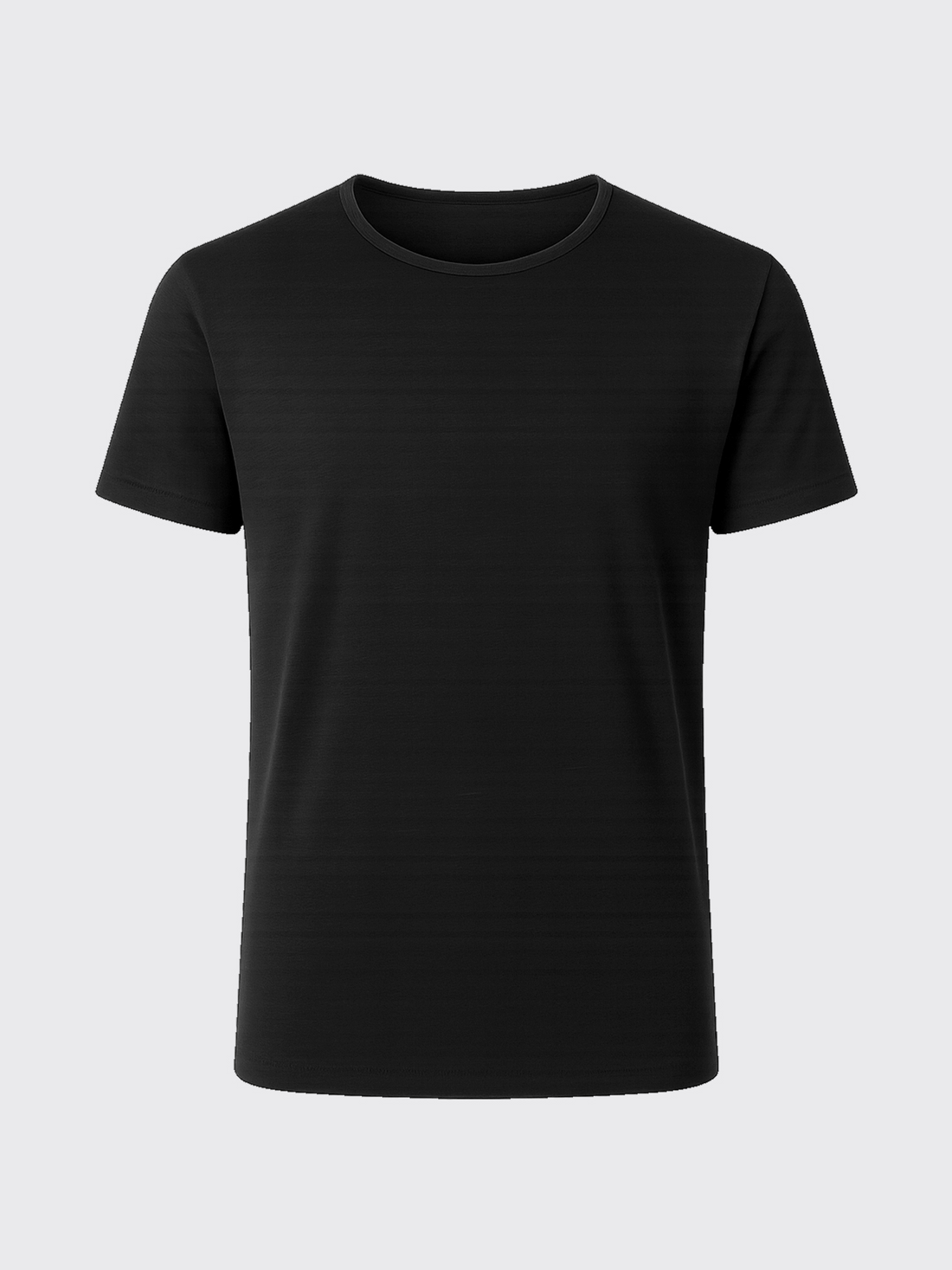 ACTION MERINO T-SHIRT
- Regular price
-
60 € - Regular price
-
- Sale price
-
60 €
-
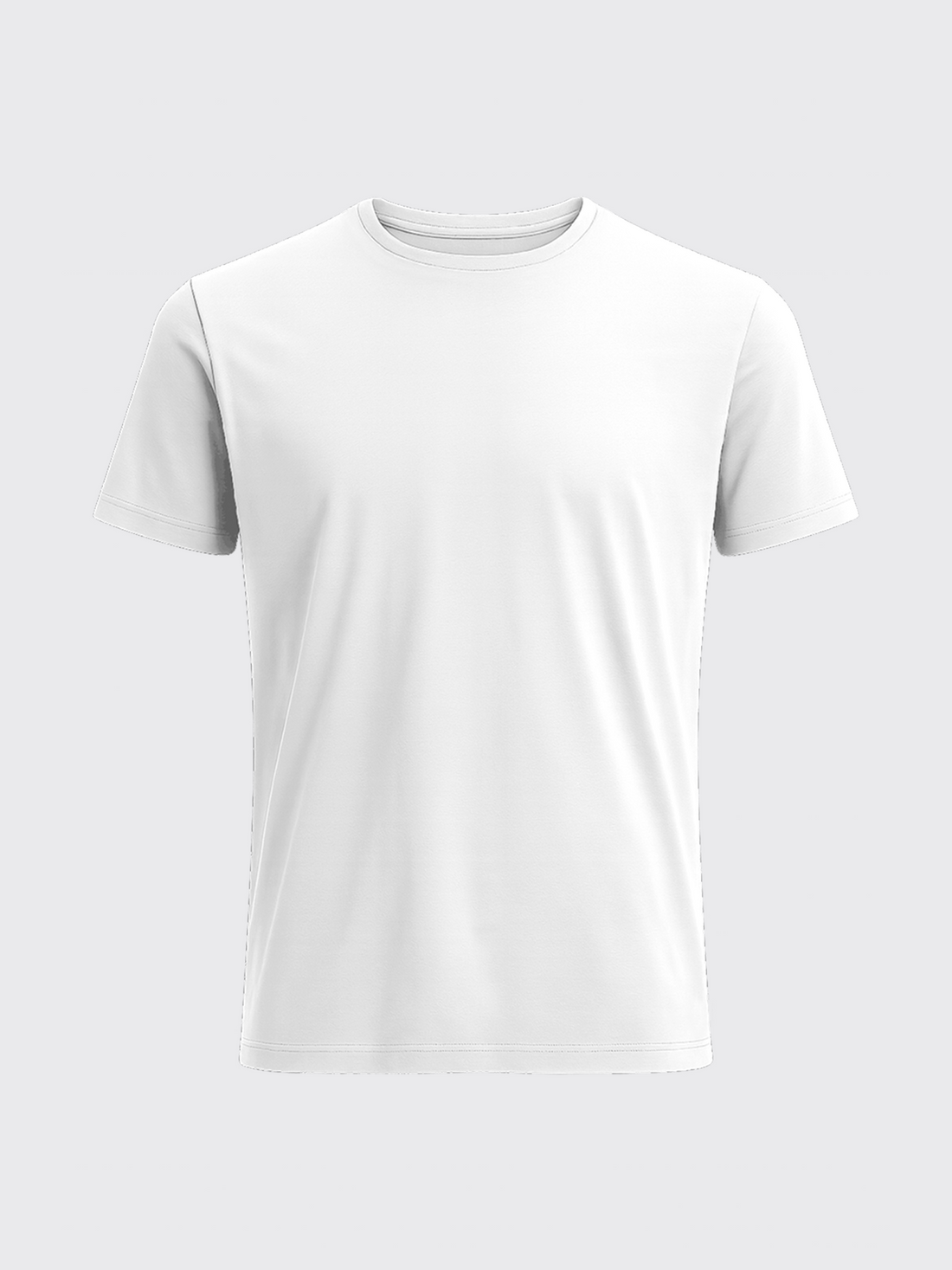 EVOLUTION MERINO T-SHIRT
- Regular price
-
60 € - Regular price
-
- Sale price
-
60 €
-
 PERFORMANCE MERINO HENLEY
- Regular price
-
85 € - Regular price
-
- Sale price
-
85 €
-
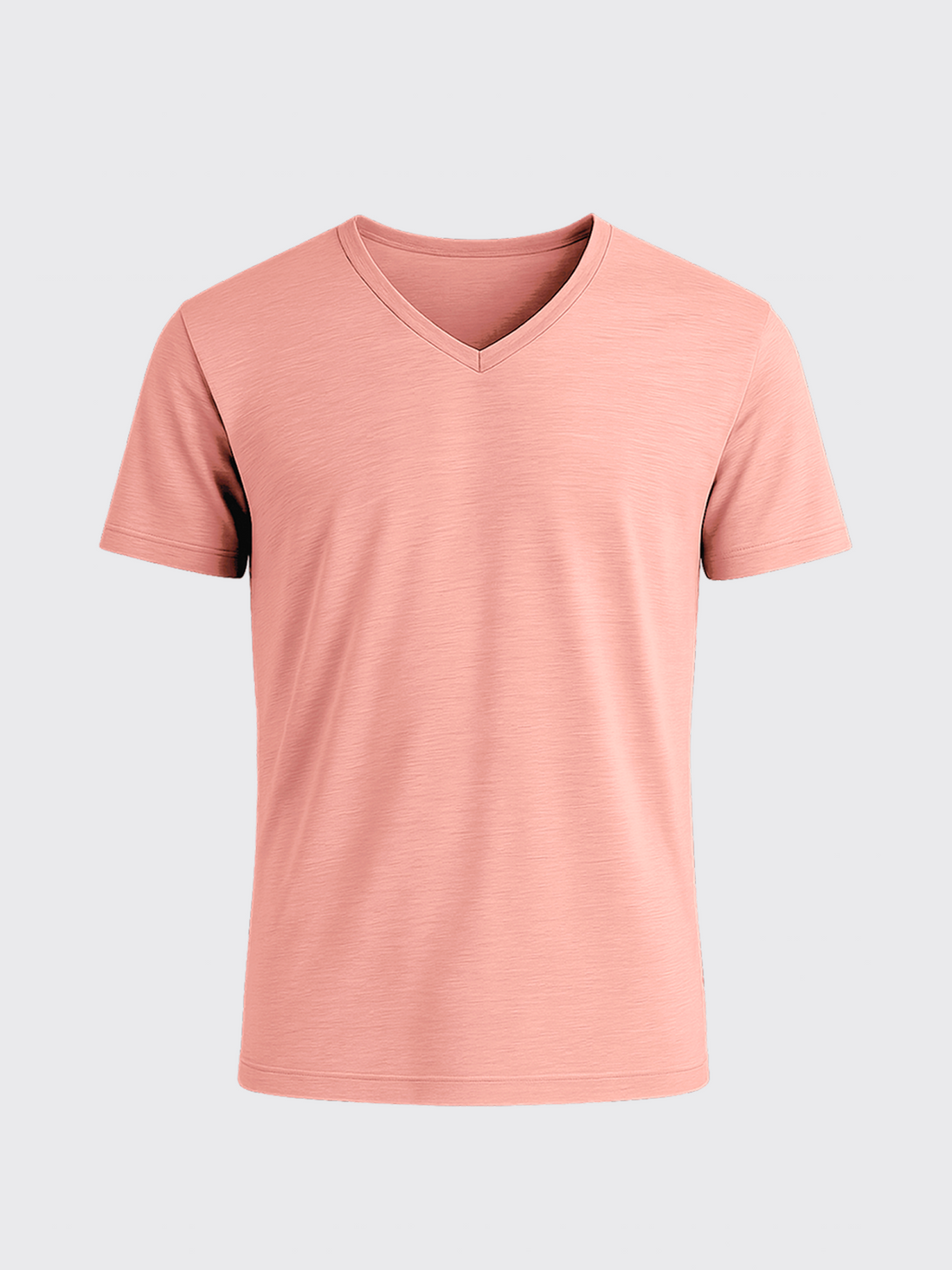 ACTION MERINO V-NECK TEE
- Regular price
-
60 € - Regular price
-
- Sale price
-
60 €